Why You Can't Just Stop and Enjoy What You Built (Trust Me, I've Tried)
You hit the goal. The number, the client, the launch you built the whole quarter around. Give it a week, maybe less, and you're already past it, eyes locked on the next one. Sound familiar? Good. There's nothing wrong with you, and this isn't some flaw in your personality that needs fixing. It's a habit. Habits are stubborn, boring, entirely ordinary things.
There's nothing wrong with you, and this isn't some flaw in your personality that needs fixing.
Annoyingly.
Mine was our boat. Dave and I spent over twelve years building our Barefoot Sunset dream: the boat, the sailing skills, the knowledge, and the thing nobody likes to admit matters just as much, the actual money to go (the sailing kitty, as we called it). Twelve years. Every bit of it in service of one single goal: leaving. Which means, if you sit with that for a second, twelve years of my life were entirely about starting something that hadn't started yet.
When we finally cast off, it took us under a year to get up the coast and across to Indonesia. Under a year, after twelve. Cute maths, really.
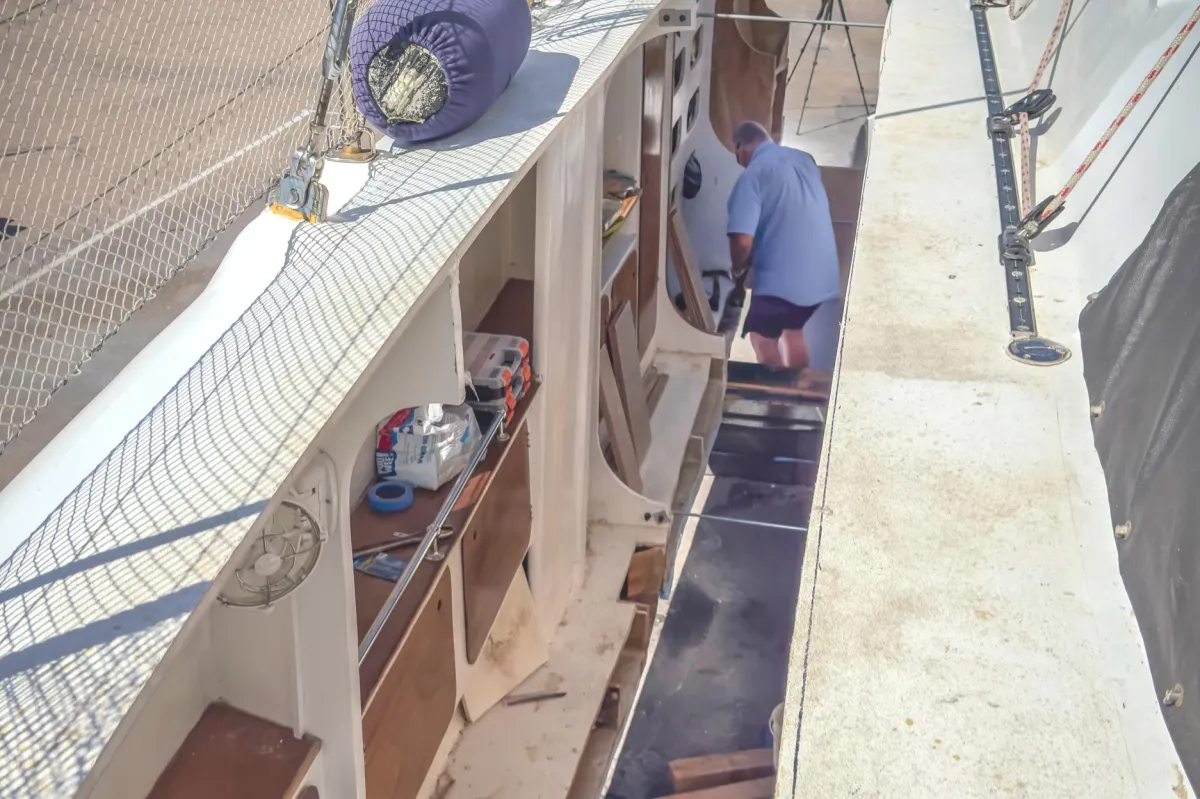
But halfway up the coast, we stopped. Properly stopped, for three months, tools out, refitting a boat we'd built for an entirely different life. Barefoot Sunset was built to live in a marina and go sailing on weekends, maybe a few days away if we were feeling adventurous. She was brilliant at that job. Then we changed the job completely: full-time liveaboard, everything we own, every day, into weather she was never built for. The boat didn't change. What we were asking of her did. That's when we found out she needed more than we'd thought.
So we cut the hulls in half. Widened her. Put in different engines. That's not a lick of paint, that's a serious rebuild, done while living on the thing with somewhere to actually be. But the bit that matters is this: it wasn't starting over. We kept what already worked and refitted it for the job we actually needed done. A refit, not a rebuild. Then we got going again.
A refit, not a rebuild.
Even the deliberate stop got recruited
What still makes me laugh at myself is this: we are, this actual minute, living the exact life those twelve years were for. Aboard. On the water. Doing the thing. And I still catch myself white-knuckling forward toward the next goal like stopping is somehow cheating. Even that three-month refit got recast in my own head as productive, because obviously, if we were fixing the boat, it still counted as forward motion. Couldn't just let a stop be a stop. Had to be earning it.
Very on brand for me. Not in a good way.
The same drive runs a business
Same pattern, dressed up in a business suit. Hit a number, and I'm past it before the feeling of hitting it has even landed. Sign a client, and I'm scanning for the next one before the ink's dry. Run an event, and I'm halfway into planning the next one before the debrief's finished. The business works. It still does. But for years I treated every single arrival as a checkpoint to blow past, not a place worth standing in for a minute.
If you've built something you care about, this gets harder to spot, not easier. When the work matters, there's always another thing worth chasing: another client, another bit of impact just out of reach, another version of the business that could go further. None of that ambition is wrong. I'd be a hypocrite of the highest order to tell you to want less. But it can turn into a habit of never quite being where you are, which is a strange way to run a business you built because something mattered to you in the first place.
The permission part
This isn't really a piece about defeating the drive. It's closer to a permission slip: you can still want the next thing and stop for this one anyway. Because this is what stopping actually looks like from where I'm sitting these days.
I watch sunsets from the front of the boat that are, frankly, ridiculous. I've walked out of client calls mid-sentence because there were whales off the bow, webcam in hand so they could see too. I bake bread because there's nowhere here to buy it. Some days I dive in the morning and work in the evening, because that's the order the day wants, not the order a calendar would give it. I have full control over my own life, and I'm spending it doing exactly what I want to do. Everything still fits. It's just fitting around my priorities now, not somebody else's idea of what a working day should look like.
The drive to do the next thing hasn't gone anywhere, and I'd be lying if I said it had. But we're starting to spend real time in the little bays tucked away in this ridiculous environment, not just passing through them on the way to somewhere else. It's everything I dreamed it would be, and nothing like I expected. The drive is still there. I'm just getting better at it.
The drive is still there. I'm just getting better at it.
The part I didn't expect is this: when I actually stop, sit still, and breathe, the ideas that turn up are better than the ones I get chasing the next thing at speed, for my own life and for my clients' problems both. I'm slowly learning that going quicker can drown out going slower, not the other way round, no matter how loudly the habit argues otherwise.
Stopping isn't a milestone, it's a practice
Twelve years of prep and one deliberate three-month refit didn't cure me of any of this. All it proved was that stopping is possible, once, under pressure, with a boat that needed the work as a decent excuse. It didn't make the next stop any easier, or the one after that. I've made my peace with that being less a personal failing and more just the price of the habit: you don't defeat it once and retire undefeated. You notice it, again, and you choose differently, again, for about as long as you're in business. Which, let's face it, is forever.
You don't defeat it once and retire undefeated.
So next time you land something you've been chasing and your attention's already halfway to the next target, do yourself a favour and ask the less glamorous question: what would it take to let this one land first, properly, before you're off again. Duller question than "what's next." Better one, though.
If you want somewhere to start, the free Business Fit Review takes about ten minutes and shows you where your business fits you right now, and where it doesn't.